
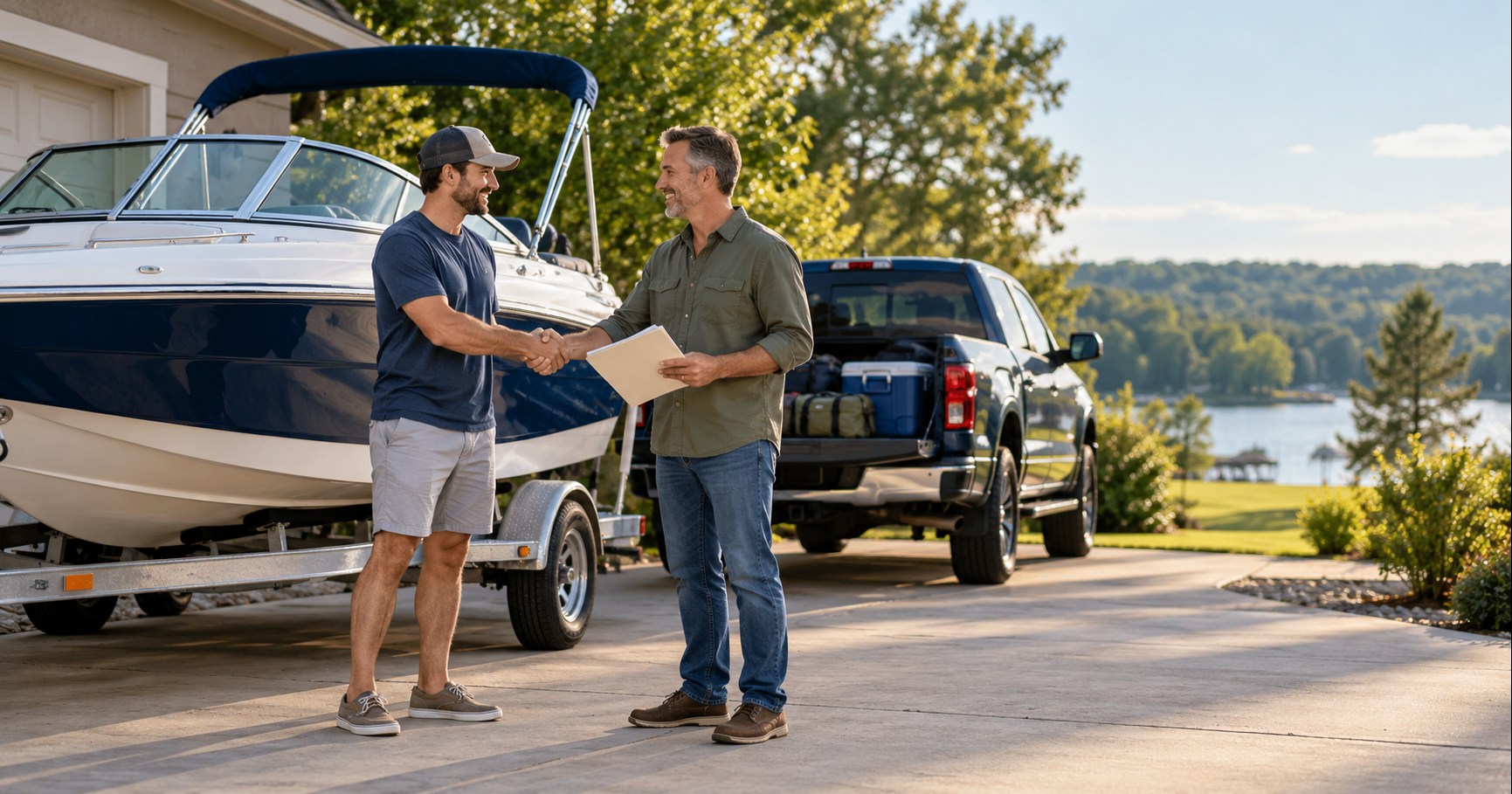
Sometimes the right boat is listed by a private owner two states away, not at the dealership down the road. Choosing to buy a boat out of state or from a private seller can open up more options, but it also puts more of the paperwork on you.
Below, we cover boat title transfer basics, what belongs in a boat bill of sale, how out of state boat registration generally works, and how lenders typically approach a private party boat loan. Much of it applies to private-party RVs, too.
Why the title and paperwork matter
A dealer usually handles much of the paperwork. In a private sale, you and the seller do. Clean paperwork:
- Proves the seller owns the boat and has the right to sell it.
- Shows whether anyone else has a claim on it, such as a bank that's still owed money.
- Lets you register the boat in your name in your home state.
- Makes financing possible, because a lender needs to secure its interest in the boat.
Title vs. registration
- A title is legal proof of ownership. It typically lists the owner and any lienholder.
- Registration allows you to operate the boat on the water in a given state, usually with numbers on the hull and a decal that's renewed periodically.
Rules vary widely by state. Some states title boats (often depending on length or whether the boat is motorized), while others only register them. So the seller's paperwork may not look like what your state expects.
Some larger vessels are instead documented with the U.S. Coast Guard, a federal form of registration. Liens on documented vessels are generally recorded with the Coast Guard rather than a state agency, so ask the seller for the current Certificate of Documentation.
RVs are simpler: motorhomes and travel trailers are generally titled and registered through a state motor vehicle agency, like a car, and identified by a VIN.
Check for liens and title problems first
Before money changes hands, confirm the boat is free and clear, or that any existing loan will be paid off as part of the sale.
- See the original title (or Certificate of Documentation) and make sure the seller's name matches their ID.
- Look for a listed lienholder. If one is named, ask for a lien release or arrange a payoff at closing.
- Check with the titling agency in the boat's current state. Many states offer title or lien lookups.
- For documented vessels, request an abstract of title from the Coast Guard to see recorded owners and mortgages.
Match the HIN (and every other number)
Most boats built since the early 1970s carry a Hull Identification Number (HIN), a 12-character number usually found on the upper right side of the transom. Make sure the HIN on the hull matches the title, registration, and bill of sale exactly. A quick tip: the last two digits of the HIN show the model year of the hull, so you can confirm the boat's year matches the listing and the paperwork.
Outboard engines and trailers may have their own titles or registration in some states. Record the engine serial numbers and trailer VIN, and confirm what both states require.
What to include in a boat bill of sale
Some states have their own required form or require notarization, so check your home state first. A thorough bill of sale generally includes:
- Buyer and seller names, addresses, and signatures
- Date of sale and purchase price
- Year, make, model, and length
- HIN, engine serial numbers, and trailer VIN
- State title/registration or documentation number
- A statement that the boat is sold free of liens, or details of any payoff
- Any terms, such as “as-is”
Along with the bill of sale, provide clear pictures of the HIN and all applicable serial numbers, such as the engine serial numbers and trailer VIN. Good photos help your lender and our Title Specialists verify the boat and keep the title work moving.
Sales tax and out of state boat registration
Buying in another state usually doesn't mean avoiding sales tax. In general, sales or use tax is owed in the state where you'll register and keep the boat. Some states credit tax already paid elsewhere; others don't. Check with your home state's revenue or titling agency before you buy.
Once the boat is home, you'll generally need to title (if your state titles boats) and register it within a set time frame.
How Vantage handles these deals
Vantage arranges financing for boats and RVs in all 50 states, and here's how private-party and out-of-state deals typically work with us:
- Lien payoff: If the seller still owes money, Vantage handles the payoff on the collateral so the title can be released.
- Title and lienholder placement: In most states, Vantage's Premium Title Service handles the title transfer and lienholder placement for you. Some states require the purchaser to complete this step in person, and if yours does, our Title Specialists will guide you through it.
- Age of the boat: Banks typically offer their best programs on collateral no more than 20 years old, though some lenders will finance boats and RVs up to 40 years old.
- Inspection or marine survey: Depending on the boat's age, size, and value, a lender may ask for one. Even when optional, it protects you.
- Extra state paperwork: Different states require different forms, and your Loan Consultant can help you sort it out.
- Closing documents: Most loans close with electronic documents. Some lenders require wet-ink signatures, and sometimes a notary is required. Your Loan Consultant will give you the closing requirements for your loan.
As a correspondent lender, we look at your full financial profile and match you with the bank that offers the best loan program for your specific financing needs. Give us a call with the details and we'll walk you through the paperwork that lender needs.
Vantage makes the transfer of title easier on you. If you check our Google reviews, you will see gratitude to our team for help with the extra paperwork their state required. Another, in Tennessee, handled everything by phone with their Loan Consultant. Don’t be overwhelmed. We are here to help with:
Buyer's checklist
- Get pre-approved so you know your budget and can negotiate with confidence
- See the original title or Certificate of Documentation
- Check for liens, match the HIN, engine serials, and trailer VIN, and take clear pictures of each
- Schedule an inspection or marine survey
- Complete a bill of sale (notarized if required)
- Check your home state's sales tax and registration rules
- Coordinate lien payoff and title transfer with your Loan Consultant and Vantage's Title Specialists
Found a boat across state lines?
Get pre-approved with a soft credit pull and let our Title Specialists help with the paperwork.
Get pre-approvedRed flags
- No title, a “lost” title, or a name that doesn't match the seller's ID
- A HIN that's missing, altered, or doesn't match
- Pressure to wire money before you've seen the boat
- A price that seems too good to be true
- Reluctance to allow an inspection, or vague answers about an existing loan
Frequently asked questions
Can I get a private party boat loan?
Yes. Vantage Recreational Finance works with lenders that finance private-party (consumer-to-consumer) loans. We'll match you with the right lender, handle the payoff on the collateral, and let you know which documents your deal requires. In most states, our Premium Title Service handles the title and lienholder placement.
Do I pay sales tax if I buy a boat out of state?
Generally, sales or use tax is owed in the state where you register and keep the boat. Check your state's rules before you buy.
How does a boat title transfer work in a private sale?
Typically, the seller signs over the title, you complete a bill of sale, and you apply for a new title and registration in your state. Any existing lien must be released and a new lienholder recorded.
Does a boat trailer need its own title?
In some states, yes. Trailers are often titled or registered separately, so check the rules in both the seller's state and yours.
Ready to finance your next boat or RV?
Whether you've found a fishing boat across state lines, an RV from a private owner, or an outboard engine, Vantage Recreational Finance can help. As a correspondent lender, we look at your full financial profile and match you with the bank that offers the best loan program for your specific financing needs, including lenders that finance private-party purchases, with the lowest rates available based on your financial profile, terms up to 240 months, low monthly payments, convenient loan closing, and programs for all credit levels. We're also proud members of the National Marine Lenders Association and the Marine Retailers Association of the Americas.
Get pre-approved today or call us at 888-577-2280. Getting started with Vantage uses a soft credit pull, which does not impact your credit score.
This article is for general informational purposes only and is not financial, legal, or tax advice. Vantage Recreational Finance is a correspondent lender, not a direct lender. All loans are subject to credit approval by the participating lender. Rates, terms, down payment, and closing requirements vary by lender and by your financial profile.
← Back to all resources